
Overview
Let an agent pay on a customer's behalf with a single-use virtual card.
Agentcard
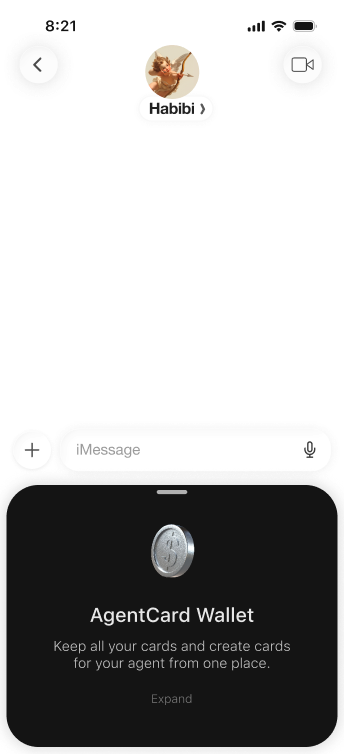
Section titled “Agentcard”Agentcard lets an agent pay on a customer’s behalf. You connect a customer once, then create a payment — the API mints a single-use virtual card scoped to that purchase, and hands the card details back for the agent to complete checkout.
How it works
Section titled “How it works”- Connect the provider. Onboard your organization with
POST /v3/payments/providers/agentcard/connect, complete the hosted flow, and you’re returned to yourreturn_url. - Connect a customer. Start a connection for a customer handle (phone/email) with
POST /v3/payments/handles/{handle}/connect. The customer completes a one-time verification through the messaging channel; aconnection.createdwebhook fires when they’re connected. - Create a payment. Call
POST /v3/paymentswith the handle, amount, currency, and merchant. The response’sstatustells you what to do next —needs_connection,awaiting_user_action(share the returned URL), orreadyonce the card is minted. - Retrieve the card. When the payment is
ready,GET /v3/payments/{paymentId}/credentialsreturns a short-lived handoff (a token + fetch URL) the agent uses to read the card number directly from the provider. Card details never pass through Linq. - Track the lifecycle. Subscribe to
payment.authorized,payment.declined,connection.created, andconnection.revoked. There is nopayment.succeededwebhook — pollGET /v3/payments/{paymentId}to confirm the charge settled.
- Amounts are in the currency’s minor units (cents for
usd). - A payment is idempotent on the
Idempotency-Keyheader. - Card credentials are display-and-use only and are never stored by Linq.
Guides
Section titled “Guides”- Quickstart — setup to payment in five steps.
- Connect a customer — connect and verify, with screens.
- Create & complete a payment — statuses and retrieval.
- Cards & credentials — the wallet model and the handoff.
- Webhooks & lifecycle — events, payloads, and signature verification.
- Agentcard vs Stripe — which provider to use when.
- Errors, statuses & go-live — the production checklist.
See the API reference for full operation, schema, and webhook details: Payments, Payment handles, Payment providers, and Experiences.